
Storming the Castle: Conventional Weapons to Breach the Walled Garden
By Pat Pascarella and Luke Hasskamp, Bona Law • Part III of a four-part series
In an earlier note, not part of this series, we sketched a framework for potential exclusionary-conduct theories against Apple built from three sources: the DOJ’s Section 2 complaint, the Epic Games litigation, and doctrine drawn from adjacent platform cases—Beyond the DOJ Complaint: Tracking Exclusionary Conduct Theories in the Apple Ecosystem May 4, 2026.
While no court has resolved any of those theories since that original note, there has been some significant movement inside and outside those dockets. That movement is worth tracking, because it impacts which arguments are load-bearing and which vehicles are actually positioned to test them.
Among the developments: the Ninth Circuit's de facto exclusive-dealing theory in CoStar v. CREXi survived a petition for certiorari; the Supreme Court agreed to hear a narrower but consequential dispute in Apple's own Epic litigation; and a new developer class action has been filed that squarely targets the iOS distribution and payment-processing markets. None of these decide whether Apple's conduct is unlawful. But together they further shape the terrain on which that question will eventually be litigated.
Given its foundational importance to this series, the May article is reprinted below, followed by a discussion of these and other recent developments.
Beyond the DOJ Complaint: Potential Exclusionary Conduct Theories in the Apple Ecosystem
Original pub May 4, 2026, refreshed September 2026, Pat Pascarella and Luke Hasskamp
Recent proceedings involving Apple Inc.—including the U.S. Department of Justice case and Epic Games v. Apple—together with developments in AI markets, suggest an evolving framework for platform-focused antitrust analysis. This article considers how those threads may fit together.
I. The DOJ Has Done Substantial Groundwork
Begin with market power. In U.S. v. Apple, the district court accepted as plausible a U.S. smartphone market in which Apple holds roughly 65%—now closer to 70%—reinforced by barriers to entry, network effects, and switching costs.
The DOJ also presents an alleged pattern of exclusionary conduct: the repeated neutralization of technologies that reduce platform dependence, including middleware, super apps, cloud streaming, smartwatches, messaging, and digital wallets. According to the complaint, each time a product threatened to make device choice less consequential, Apple constrained or neutralized it. If this allegation is supportable, such a pattern could address concerns about improperly “punishing success.”
II. The Markets Apple Controls at 99 Percent
If a higher market share is needed, the more compelling market is not some smartphone submarket. Rather, it will be markets Apple controls at 99 percent: the iOS functionalities and apps themselves. While not every function is a separate product, some may well be— particularly those Apple allegedly targets.
Epic v. Apple is instructive on this point, and not fatal. The court did not hold that iOS-tethered markets are inherently non-cognizable— only that Epic failed to establish that consumers lacked awareness of iOS restrictions and could not factor them into purchasing decisions. But those gaps seem addressable.
The full scope of any restraints—and their costs—is obscured in a dense web of contractual and technical restrictions. No reasonable consumer could anticipate the extent to which app review, API access, and distribution control could be wielded against rivals. Nor should antitrust liability turn on whether consumers anticipated unlawful conduct.
Even if consumers had advanced knowledge of such restraints, a single-brand market is not foreclosed. Apple’s own counsel acknowledged in Epic that consumers entering the iOS ecosystem cannot predict downstream costs related to app distribution, in-app payments, or aftermarkets. If the costs of any restraints are unknowable at the time of purchase, foremarket competition cannot discipline aftermarket conduct. The remaining elements of a single-brand iOS functionality or app market also appear to be present, including allegations of intentional degradation of interoperability to maintain switching costs—without corresponding loss of share or margin.
III. CoStar, Exclusive Dealing, and the End User License Agreement
Some claims may not require pleading a single-brand market. For example, under the Ninth Circuit’s decision in CoStar v. CREXi, “substantial foreclosure” is sufficient to plead an exclusive dealing agreement.
The agreement? The EULA itself. While a web of contractual and technical restrictions might enable foreclosure, the enforceable agreement between Apple and the user is embodied in the EULA. In that sense, Apple may have supplied potential plaintiffs with the central instrument of its own potential liability.
IV. The EULA as a Negative Tie
The EULA may also provide a foundation for tying claims. Courts often resist tying theories in platform cases, frequently reasoning that coercion must be directed at consumers rather than suppliers. That argument, though contestable, is predictable.
A potential response may be that it is the EULA that effectively conditions use of the platform on the consumer’s agreement not to obtain competing products, services, or apps outside Apple’s approval.
V. Attempted Monopolization and Dangerous Probability of Success
Tying allegations also expand the analytical framework, though courts ultimately may analyze them as attempted monopolization. On the “dangerous probability of success,” a defendant such as Apple likely would invoke concerns about outdated leveraging theories. But this would not be a classic leveraging case.
Any company that demonstrates both the ability and the willingness to neutralize technologies or rivals that threaten its market position may struggle to characterize that conduct as competing on the merits. Such a pattern should reduce concerns about punishing a company simply for being successful. Where a company has demonstrated a pattern of exclusion and retains the ability to repeat it, the “dangerous probability” standard should be satisfied.
VI. Inextricably Intertwined—and Antitrust Standing
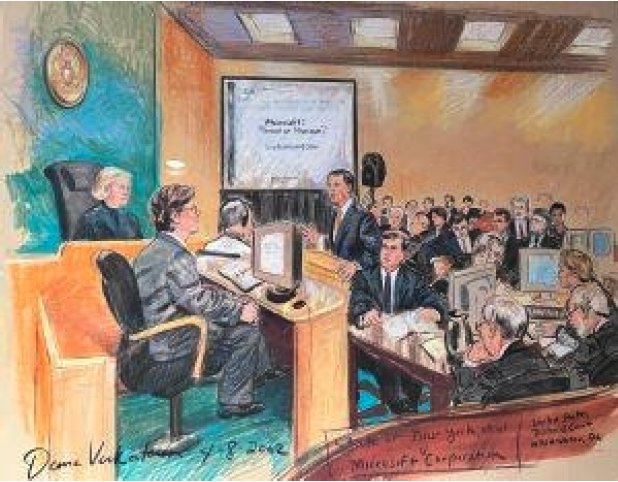
While U.S. v. Apple and Epic are instructive, U.S. v. Microsoft is more likely the template to challenge any anticompetitive conduct by a platform. Microsoft established that a dominant platform’s use of contractual restrictions and technological shackles to exclude middleware that threatens its operating-system monopoly is exclusionary conduct under Section 2—not competition on the merits.
The historical irony is worth noting: during the Microsoft trial, an Apple executive testified about Microsoft’s efforts to undermine Apple’s cross-platform technology, QuickTime, to preserve its operating system dominance. The resulting ruling constrained Microsoft’s conduct and helped create the competitive space in which Apple introduced the iPod, iTunes, and ultimately the iPhone.
Since the publication of the above article, a number of important developments have occurred.
1. CoStar’s Exclusive-Dealing Theory: Cert Denied.
Following its loss at the Ninth Circuit, CoStar petitioned the Supreme Court, framing the question presented as whether a “de facto” exclusive dealing claim is cognizable under the Sherman Act in the absence of exclusive contractual terms, programs, or policies. That is the type of objection a defendant would raise against the EULA theory.
Following its loss at the Ninth Circuit, CoStar petitioned the Supreme Court, framing the question presented as whether a “de facto” exclusive dealing claim is cognizable under the Sherman Act in the absence of exclusive contractual terms, programs, or policies. That is the type of objection a defendant would raise against the EULA theory.
On March 23, 2026, the Supreme Court denied certiorari. The denial does not endorse the Ninth Circuit’s reasoning, of course. It simply leaves the holding intact and controlling within the circuit.
2. Epic v. Apple: A Preview of the Remedies Fight, Not a New Liability Ruling
Epic v. Apple continues to generate rulings. The underlying 2021 trial already resolved the antitrust merits: Apple defeated Epic’s federal Sherman Act claims and lost only on a narrower state law theory targeting anti-steering provisions. Nothing has since reopened that liability determination.
What has continued is a fight over enforcement of the resulting injunction. In December 2025, the Ninth Circuit largely affirmed the district court’s finding that Apple’s post-injunction commission structure and link restrictions violated that order. But it did narrow the remedy, holding that certain aspects of the district court’s order swept more broadly than necessary and remanded those narrower questions for further consideration.
Then, on June 30, 2026, the Supreme Court granted certiorari on a single question: whether a party may be held in civil contempt for violating the “spirit” of an injunction that is silent on the specific conduct at issue, or whether contempt requires a clear and unambiguous textual violation. Apple’s opening brief is due September 14, and Epic’s answering brief is due November 13. Amicus briefs are due seven days after the brief of the party they support, so “friends of the Court” should consider whether to weigh in.
The resolution of that question will matter to anyone considering potential remedies. If a court ultimately finds liability under a single-brand market theory, an exclusive-dealing theory built on the EULA, or an attempted-monopolization theory premised on a pattern of neutralizing rivals, the Apple v. Epic contempt fight is a preview of how difficult it can be to translate a liability finding into an enforceable, compliance-proof remedy against a platform that controls the technical means of compliance.
3. New Vehicles: Where These Theories Might Actually Be Tested
The DOJ’s Section 2 case in the District of New Jersey remains in the pretrial phase. Judge Neals denied Apple’s motion to dismiss in June 2025, and the litigation since then has been consumed by discovery disputes. But reports suggest that Apple is engaged in some settlement discussions with the DOJ.
No court has yet resolved on the merits the single-brand iOS-functionality market theory, the pattern-of-exclusion argument, or the “inextricably intertwined” standing theory described in our earlier note.
A more direct vehicle may be developing on the private side. Proton AG is among the plaintiffs in a consolidated developer class action, In re Apple App Developer Antitrust Litigation, No. 4:25-cv-04438 (N.D. Cal.), before Judge Gonzalez Rogers, who tried Epic. The action alleges monopolization of the iOS app-distribution and app-payment-processing markets. It described Apple’s EULA-based restrictions and technical controls as the mechanism of exclusion. That pleading also remains untested, but it is, structurally, close to the single-brand market and EULAas- restraint theories.
Separately, the long-running consumer class action, In re Apple iPhone Antitrust Litigation, was decertified in October 2025 after the district court found the plaintiffs’ damages model incapable of reliably showing class-wide injury. The Ninth Circuit agreed to hear plaintiffs’ appeal of that decertification. That dispute is about damages methodology, not about whether Apple’s conduct is exclusionary, but a reversal would return a large class action to active status and could accelerate the pace at which a jury resolves some of these questions.
4. Looking Ahead
Taken together, these developments suggest 2027 is likely to be the window in which a court, and perhaps a factfinder, finally engages the substance of these theories rather than their pleading-stage plausibility.
Part II: Study the Past to Define the Future: United States v Microsoft
Coming Soon:
Part IV: The Trebuchet: AI